
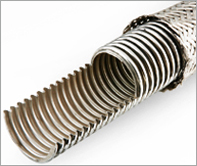
Most early stainless steel hose failures come from corrosion, over-bending, vibration, twisting during fitting, or the wrong grade rather than the metal itself. Each cause starts as a small, hidden damage near bends and fittings. Regular hand checks along the hose catch these faults before a line fails mid-shift.
Key Takeaways
- A stainless steel hose rarely fails because of the metal itself. The fault usually sits in the fitting, the installation, or how the line gets handled day to day.
- Chlorides from salt water, cleaning agents, and coastal air pit the surface and crack it from within. A 316 grade with molybdenum resists this far better than plain 304.
- Over-bending past the minimum radius, vibration near pumps and compressors, and twisting during installation all build fatigue that cracks the hose over time.
- A quick hand check along the hose, feeling for stiff patches and kinks and inspecting the braid near each fitting, catches most faults before the line lets go mid-shift.
A hose should give you several years of service. When one fails early, the metal alone rarely deserves the blame. Something in the fitting, the setting, or the daily handling cut its life short. However, most of these factors can be avoided if you are familiar with their characteristics. They may seem strong enough at first glance when walking around them on the factory floor. The outer braiding is able to conceal a lot from the untrained eye. Any cracks usually begin small and usually form in areas not visible. By the time fluid weeps through the wall of a stainless steel hose, the real damage sits well behind it. So catching the early signs matters more than people tend to think.
Chloride Corrosion and Your Stainless Steel Hose
People assume that a stainless steel hose never rusts. It resists rust well, yes, but chlorides wear that defence down. Salt water, certain cleaning agents, and coastal air all carry them. They pit the surface first, then creep inward as fine cracks. A 316 grade with molybdenum holds up far better here than a plain 304. So the fluid and the air around the line both shape how long the hose survives.
Over-Bending a Hose Past Its Bend Radius
Every metal hose has a minimum bend radius. Apply more pressure, and the corrugations within the curve will begin to get distorted. You can probably get away with doing this one time, but repeat it every day, and fatigue cracks will appear at that spot in the curve. A loop that looks neat to the eye can still sit below the safe radius. Give the hose room to curve gently, and it serves you a good deal longer.
Vibration Fatigue in Stainless Steel Hose Lines
Pumps, compressors, and engines shake the lines bolted near them. A stainless steel hose flexes with that motion, again and again, thousands of times an hour. Metal does not take kindly to that. It work-hardens at the flex point and turns brittle. Cracks follow soon after. Mount the hose so it absorbs the movement rather than fighting it, and you draw most of that strain away.
Twisting the Hose During Installation
This one slips past a lot of fitters. As you tighten a coupling, the hose can twist along its length if you are not careful. That stored tension sits in the braid and weakens it from the start. A simple marker line drawn down the hose shows any twist at a glance. Hold one end steady, turn only the nut, and the hose stays straight.
Choosing the Wrong Grade for the Job
Not every stainless steel suits every line. A grade picked mainly on price might lack the corrosion resistance the fluid actually needs. Heat matters too, since temperature changes how the metal behaves over months of use. Matching the grade to the medium, the pressure, and the working heat sounds obvious enough. Yet plenty of early failures trace straight back to a hose that never fitted the job in the first place.
Just an occasional inspection will spot these problems before they can spread. Slide your hand down the length of the hose, feeling for stiffness and kinks. Examine the braiding near each coupling, since that is where the strain starts to show up. A fault spotted at that stage costs a fraction of a line that lets go halfway through a shift.


Leave a Reply